German Address Format: Street First, Postcode Before City
Short answer
A German address puts the house number after the street name and the five-digit postcode before the city: name, Musterstraße 12, 10115 Berlin. There is no comma and no blank line. From abroad, add GERMANY in capitals as the last line and never write D- or DE- in front of the postcode.
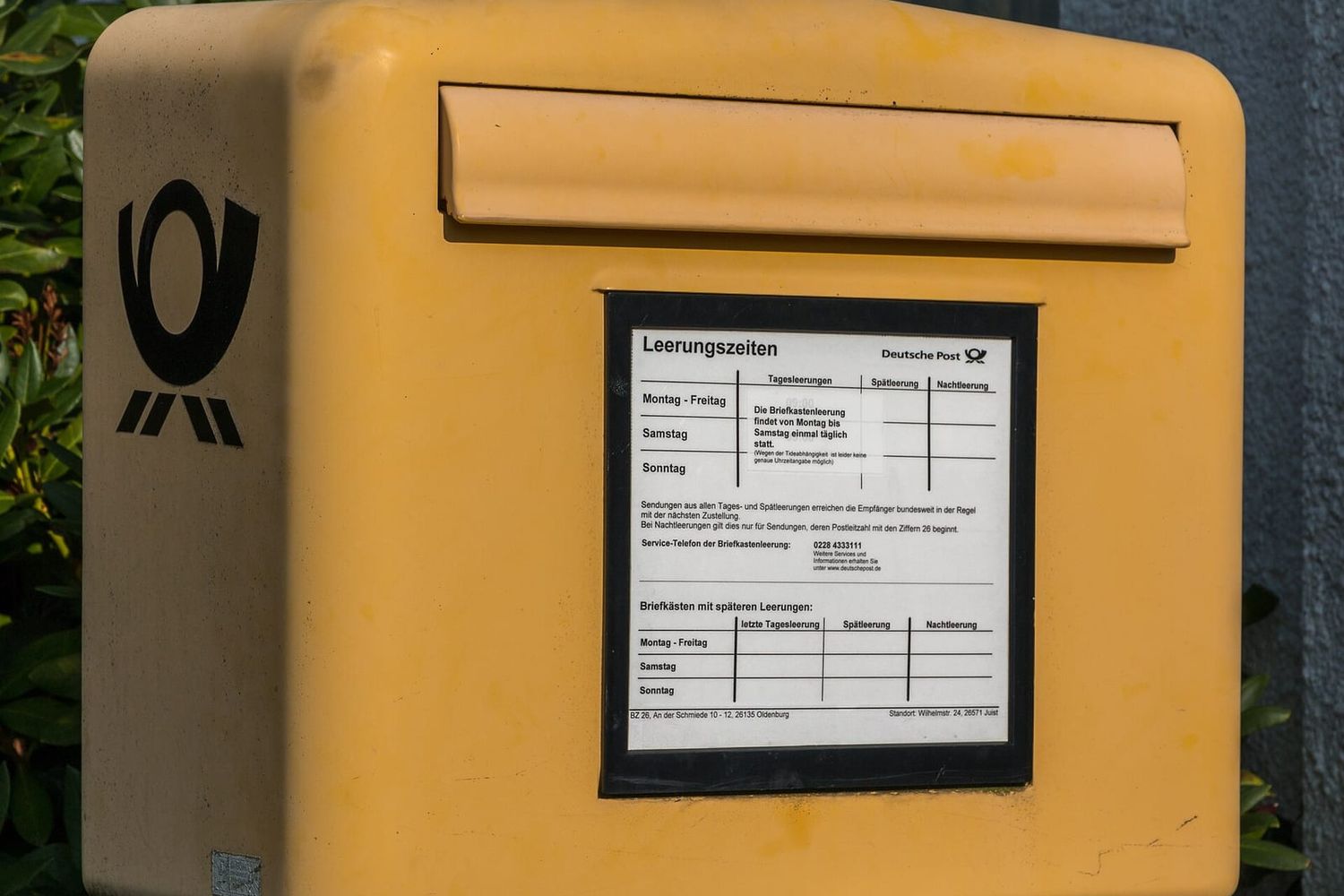
Germany flips two things that English speakers take for granted. The house number follows the street, and the postcode precedes the city. Get those two right and you have most of the German address format. The rest is detail, though some of that detail decides whether a parcel lands in a Packstation locker or comes back to you.
The rules here follow Deutsche Post’s entry in the UPU address catalogue and its own guidance on addressing envelopes, which is in German.
A standard German address, line by line
Here is the example Deutsche Post itself uses in the UPU catalogue, written as it would arrive from abroad:
Herrn
Quincy Happy
Wacholderweg 52a
26133 OLDENBURG
GERMANY
Four things to notice. Herrn (Mr) sits on its own line, which is traditional but optional. The street and number form one unit, with the suffix letter a attached to the number. The postcode comes first on the city line, separated by a single space. And the city is in capitals because the letter crosses a border; domestic mail usually writes 26133 Oldenburg.
| Criterion | Germany | United Kingdom | United States |
|---|---|---|---|
| House number | After street: Wacholderweg 52a | Before street | Before street |
| Postcode position | Before city, same line | Own line after town | After state, same line |
| Postcode shape | 5 digits | 5 to 7 characters | 5 or 9 digits |
| Region or state line | no (county optional) | yes, 2-letter code | |
| Country prefix before postcode | never | never | never |
Source: Deutsche Post, Royal Mail and USPS entries in the UPU address catalogue
Deutsche Post also asks for no blank line between the street and the city line, the same font and size throughout, dark text on a light background, and no frames or highlighting. The UPU sheet gives a maximum width of 10 cm for the address block.
Postcodes: five digits, and some start with zero
German postcodes (Postleitzahl, PLZ) have had five digits since the postal code reform of 1993. The first digit is a broad zone. Zone 0 covers parts of eastern Germany, which is why Dresden addresses begin with 01. If your database stores postcodes as numbers, 01067 becomes 1067, and every validation rule downstream fails. Store them as text.
The postcode always goes before the city, on the same line: 10115 Berlin, never Berlin 10115. Some large organisations have their own postcode. The UPU sheet’s example for such a “large volume receiver” has only two address lines: the company name and 68151 MANNHEIM. No street at all, because that postcode belongs to one recipient.
A simple pattern check for the format is five digits with nothing else. Our article on postcode regular expressions explains why that check is weaker than it looks.
Flats, districts and c/o
German forms rarely have a separate field for a flat number, and German addresses often do without one. Many apartment buildings rely on names on the letterboxes rather than flat numbers. When a flat number is needed, the UPU catalogue shows the double-slash notation:
Liselotte Sommer
Rhondorfer Str. 666 // Appartment 47
50939 KÖLN
GERMANY
You will also see building parts written on a separate line between the name and the street: Hinterhaus (rear building), Seitenflügel links (left side wing), 3. OG (third floor). Deutsche Post puts a district name (Ortsteil) in the same spot, between name and street, as in the UPU example Ortsteil Neukoelln above Alt-Britz 73, 12359 BERLIN.
For someone staying with another person, the line c/o plus the householder’s name goes between the recipient and the street. If the name on the letterbox does not match the name on the parcel, carriers may not deliver; the c/o line solves that. For checkout forms, all of this belongs in what English forms call address line 2.
PO boxes, Packstation and poste restante
| Type | How it is written | Watch out for |
|---|---|---|
| Postfach (PO box) | Postfach 3 41 41, then 10724 BERLIN | Digits in pairs from the right; no street line |
| Packstation | Name, Postnummer, Packstation 101, then PLZ and city of the station | Postnummer has 6 to 10 digits and is mandatory |
| Postfiliale | Name, Postnummer, Postfiliale 512, then PLZ and city | Same Postnummer rule |
| Postlagernd (poste restante) | Name, Postlagernd, then PLZ and city | Collected at the post office |
The pairing of PO box digits is a Deutsche Post recommendation from the UPU sheet: group the number in twos, starting from the last digit, so 34141 becomes 3 41 41. It is a readability aid, not a hard rule, but it is what the post office prints itself.
Packstations are DHL’s parcel lockers. A Packstation address has no street in the usual sense. The line where the street would go reads Packstation 101, the name line or an extra line carries the recipient’s Postnummer, and the postcode is that of the locker’s location. Deutsche Post’s own page lists the fields as name, Postnummer, Packstation number, then postcode and city. Shops that insist on a “real” street address, or that cap the street field at a house number pattern, lock these customers out. For letter mail, Deutsche Post names large letters and Warensendung items as the formats that can go to a Packstation, so a standard letter is better sent to a street address.
Sending mail to Germany from abroad
From outside Germany, three rules matter more than anything else:
- Street name first, then house number:
Hauptstraße 5 - Five-digit postcode before the city, one space:
80331 München - City in capitals is preferred on international mail:
80331 MÜNCHEN - No
D-,DE-orGER-in front of the postcode GERMANYalone on the last line, in capitals- For a Packstation: Postnummer present, street line reads
Packstationplus its number
The ban on country prefixes surprises people who remember the old D-80331 style. The UPU sheet is blunt about it: on no account should a country code be written before the postcode, because it can delay processing on sorting machines. The general rules for country lines and languages are in how to address international mail.
Umlauts and ß are fine. München and Kölner Straße print and sort correctly in Germany. If your label printer cannot handle them, the standard transliteration is ae, oe, ue and ss, so Muenchen and Koelner Strasse.
Checking a German address before you ship
Our address format checker knows the German rules: it flags a postcode that is not five digits, a house number written before the street, a missing number, and a Packstation address without a Postnummer. It runs in your browser and prints the block in Deutsche Post order.
It cannot confirm that Wacholderweg 52a exists in 26133. That takes a match against Deutsche Post’s reference data, which its subsidiary Deutsche Post Direkt sells through products such as ADDRESSFACTORY. Their Adress-Studie 2025 found that 13.2 percent of customer addresses held by German companies were faulty, up from 12.6 percent two years before. For a shop with a large German customer base, that number makes the case for a cleanse, and teams that need it wired into their order flow can ask a data studio like OnlineBuilders.
For one parcel, though, check the street-number order and the postcode, run the address through the checker, and print what it returns.
Address format checker: Checks postcode format, house number and line order against the postal rules of the selected country, and prints the address in the format the post expects.
Questions people ask
Does the house number come before or after the street in Germany?
After. Germans write Hauptstraße 5, not 5 Hauptstraße. Letters such as 12a or 52a are part of the house number and are written straight after it, without a space in the usual form.
Should I write DE- or D- before a German postcode?
No. Deutsche Post's entry in the UPU address catalogue says a country code must not be written in front of the postcode, because it can delay machine sorting. The country goes on its own last line instead.
What is Herrn on a German envelope?
It is the accusative form of Herr, meaning Mr, and it traditionally sits on its own line above the name. It is optional. Frau (Ms or Mrs) does not change form.
Can I send a letter to a Packstation?
Deutsche Post names large letters (Groß- and Maxibrief) and Warensendung items as the letter products a Packstation accepts. For an ordinary standard letter, use a street address or a PO box. The recipient's Postnummer, a customer number of six to ten digits, is mandatory.